

Every piece of habit advice eventually comes back to the same thing.
Try harder. Be more disciplined. Wake up earlier. Want it more.
And maybe that works for some people. But for most people it works for about nine days and then life gets in the way and they are back to where they started, now with the added bonus of feeling like they failed.
Here is what that advice gets wrong. Discipline is not a character trait. It is a resource. It runs out. And building a life around the assumption that you will always have enough of it is how most self-improvement attempts quietly fall apart.
The better approach is to stop fighting how the brain actually works and start using it.
Your Brain Is Lazy On Purpose
The brain’s default setting is efficiency.
Every habit, good or bad, exists because the brain found a shortcut and decided to keep it. Habits are not failures of character. They are the brain doing exactly what it was designed to do. Finding the fastest route between a trigger and a reward and automating it so it does not have to think too hard next time.
This means the brain will always, without exception, gravitate toward the path of least resistance. Not sometimes. Always. The moment conscious willpower drops, the automated system takes over and does what it has always done.
You cannot out-discipline that system. But you can redirect it.
Friction Is the Whole Game
Research from behavioral science consistently points to one variable that predicts habit formation better than motivation, intention, or desire.
Friction.
How many steps does it take to do the thing. That is it. That is the whole equation.
BJ Fogg’s research at Stanford found that behavior is a function of motivation, ability, and a prompt. Most people try to fix motivation. The far more reliable lever is ability. Make the behavior easier and it happens more. Make it harder and it happens less. Motivation barely moves the needle by comparison.
This is why someone can genuinely want to eat better and still reach for the thing that is closest when they are hungry at 10pm. The wanting is real. But the friction between them and the bad option is lower than the friction between them and the good one. The brain solves for friction, not intention.
Booby Trap the Bad Ones
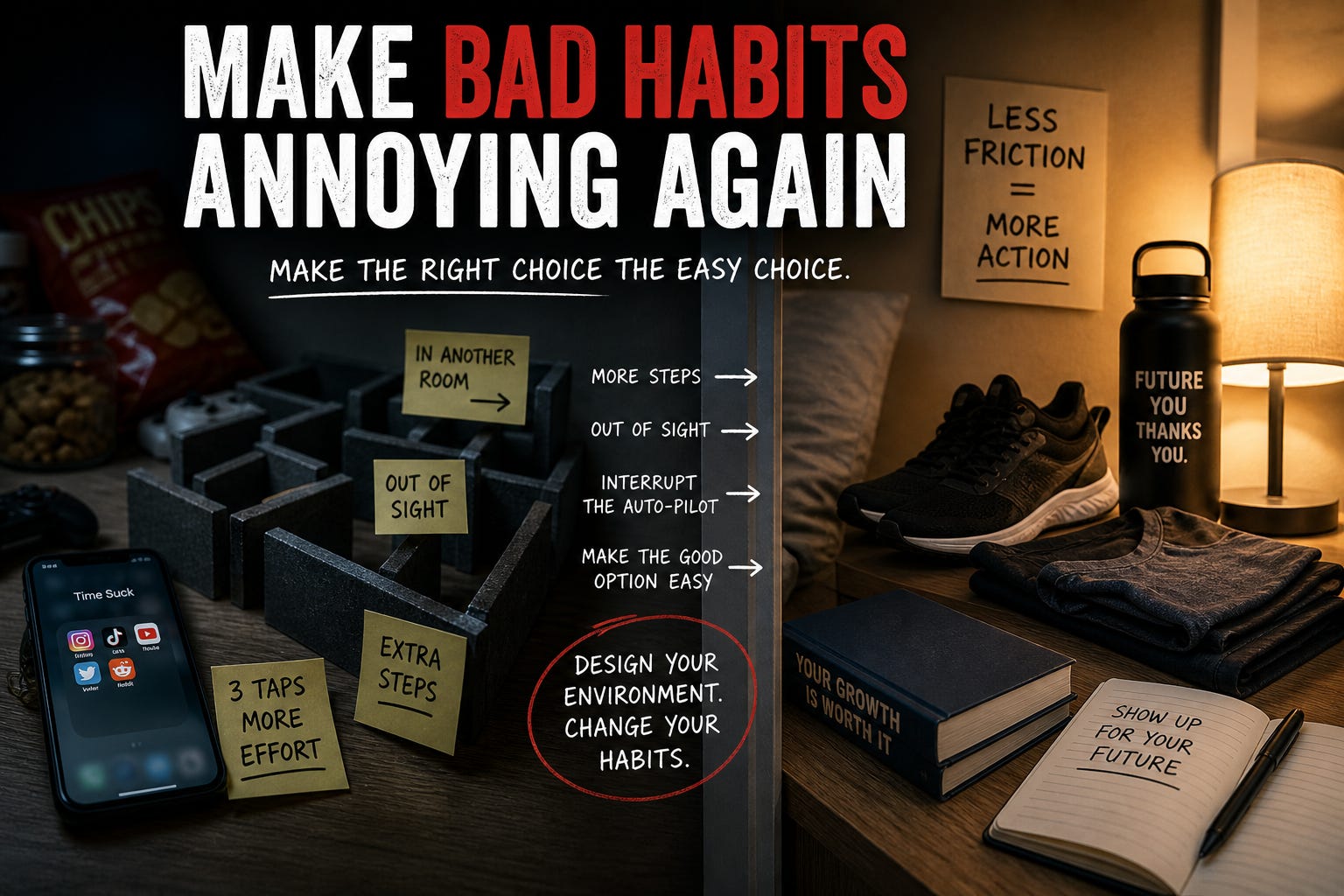
If friction determines behavior, the most direct intervention is to add it to the habits you want to break.
Not dramatically. Small amounts of friction are enough to interrupt the automatic loop.
Delete the apps you mindlessly open from your home screen. Put them in a folder three taps deep. That three seconds of extra effort is enough to break the automatic reach-and-open pattern for a significant portion of the attempts. You are not making it impossible. You are making it just annoying enough that the brain pauses before it commits.
Put your phone in another room before bed instead of on the nightstand. Move the snacks you are trying to avoid to the back of a high shelf and put something else at eye level. Unplug the TV and put the remote in a drawer instead of on the armrest. None of these are dramatic. All of them work because they interrupt the zero-effort path to the behavior.
The bad habit does not disappear. It just stops being the easy option.
Remove Friction From the Good Ones
The same logic runs in reverse.
If you want to exercise in the morning, sleep in your gym clothes. Put your running shoes at the door. Remove every step between waking up and starting. The more friction you remove from a behavior you want to build, the more likely the lazy brain is to default to it.
Prepare tomorrow’s healthy lunch tonight so the good option is the closest one when you are hungry. Put the book on your pillow instead of on the shelf. Lay the journal out open on your desk. Make the right behavior the one that requires the least effort and the brain will find it on its own without you having to will yourself into it every single time.
This is not a hack. It is just working with the architecture of the brain instead of against it.
The Environment Is the Habit
Here is the uncomfortable truth underneath all of this.
Most of your habits are not really yours. They are your environment’s.
The phone on the nightstand is not a choice you make every night. It is the default setting of a room that was never designed with your behavior in mind. The snacks at eye level are not a temptation you overcome or fail to overcome. They are just the closest thing when the brain sends a hunger signal.
Change the environment and the behavior changes without requiring any willpower at all. That is the point.
Discipline is useful. But it is expensive and it runs dry. The people who build habits that actually stick are not the most disciplined ones. They are the ones who set up their surroundings so that the lazy option and the right option are the same thing.
Stop trying to be a different person. Just rearrange the room.
excellent food for my brain to reset
Very interesting. Some great ideas.